
What if song and dance were more than performance but a way to carry history, identity, and spirit across generations?
Nā Wetini Herewini
Te Whānau a Apanui, Ngāti Porou, Te Rarawa
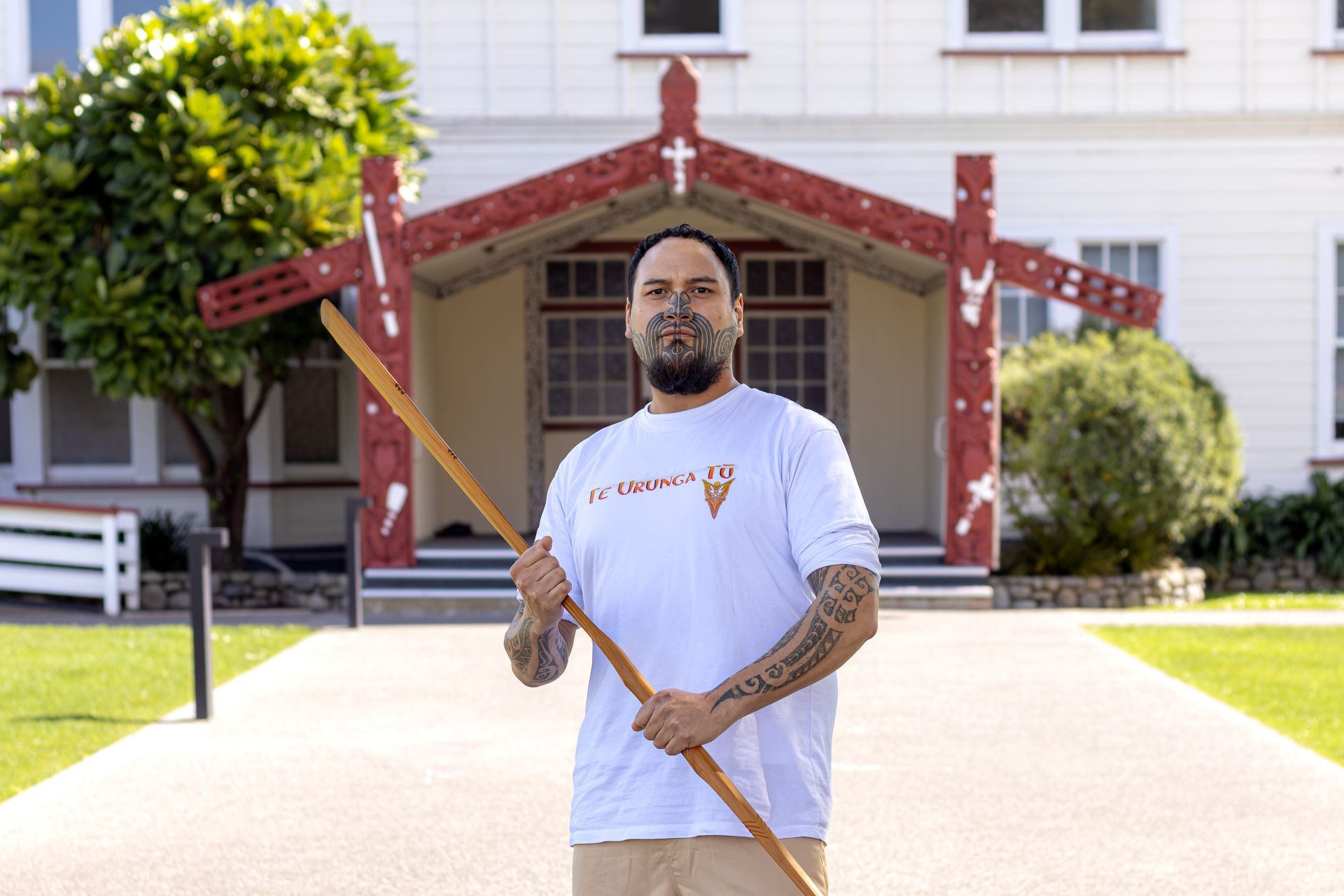
Join us on a journey into the world of Te Whare Tapere, a living tradition of Māori performing arts that weaves together storytelling, music, movement, spirituality, and community.
Through this journey, we invite you not only to understand Māori performance, but to feel its meaning.
Ngā mahi ā rēhia, the practices of Whare Tapere are not simply about entertainment. They are about connection.
Connection to our taiao, the natural world: te whenua, te moana, te rangi, the land, the sea, the sky.
Connection to our mātua tūpuna, our ancestors.
And connection across time, the past, the present, and the future.
Song and dance are expressions of identity, who you are, where you come from, and who your ancestors are. Waiata, in particular, is a vessel that carries history. Before written language, knowledge lived in memory and performance was one of the most powerful ways to preserve and pass it on.
This brings us to Whare Tapere.
While it is often translated as “house of entertainment,” that definition doesn’t fully capture its depth. A Whare Tapere was a space, sometimes physical, sometimes simply a gathering, where communities came together to share stories, music, games, dance, and laughter. It was a place of creativity, learning, and connection. A place where relationships were formed, and at times, where aroha was found.
Heoi anō, tērā tērā.
Within our traditions, oriori (ancient lullabies) were often composed for tūpuna, sometimes even before they were born. They carry references to places, ancestors, and guidance for life.
Many of these waiata have endured across generations and are still sung today.
That is the power of waiata.
A snapshot in time.
A window into the lives of our tīpuna.
A carrier of tikanga and kōrero tuku iho.
This is the power of Te Whare Tapere.
Within these spaces, people expressed themselves through many art forms — sung poetry, storytelling, string games, musical instruments, haka, poi and more. But unlike Western traditions, these were not separated into categories like music, theatre, or dance. Instead, they were interwoven; experienced as one.
Waiata often holds a softer, but deeply powerful emotional expression. Through waiata we share joy, sorrow, longing, love, and remembrance.
Every performance is grounded in whakapapa, in connection.
Equally important is wairua, the spiritual dimension. Māori performance carries a presence that goes beyond what you see and hear. It is something you feel. That moment when a karanga is heard and the hīnawanawa rises, the hairs on the back of your neck stand up — that is wairua in motion.
So what does this mean for visitors to Aotearoa, or for those who are new to kapa haka?
It means that when you experience Māori performance, whether it is waiata, kapa haka, haka or poi, you are not just watching a show. You are witnessing a living culture.
These traditions are not relics of the past. They continue to evolve and thrive. Our rangatahi are creating new and innovative expressions, bringing in new influences while holding fast to the essence of who we are.
You don’t need to understand every word or gesture. You can feel the wairua of what is being shared.
And perhaps, in doing so, it may invite you to reflect on your own traditions. Every culture carries its own stories, its own forms of expression.
Māori song and dance remind us that art is not separate from life, it is life.
It connects us to our past, grounds us in the present, and carries us into the future.
As regional kapa haka competitions take place across Aotearoa, leading to Te Matatini, we continue to see the strength and vitality of these traditions expressed on stages throughout the motu. Te Wānanga o Raukawa are proud partners of Te Matatini and Whakaata Māori.
He toi whakairo, he mana tangata
This kōrero was first presented for to Indigenous Filmmakers at the recent Māori Land Film festival. To learn more about Poutuarongo Whare Tapere click here.
